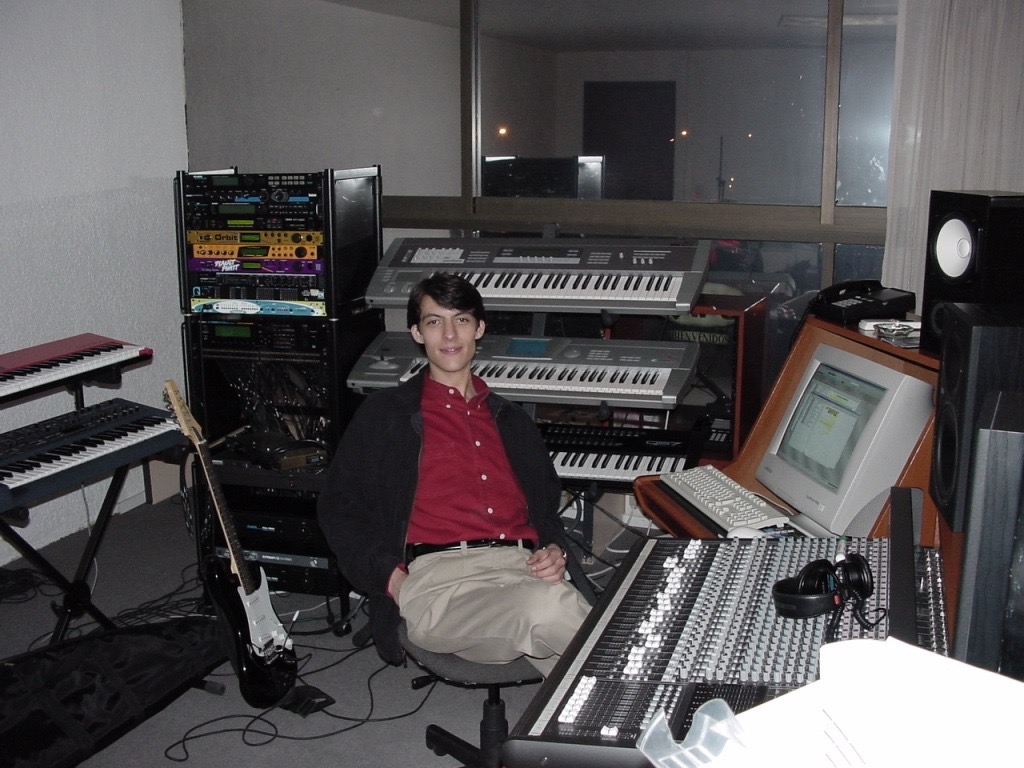
 I have produced music since I was a teenager. Not as a hobby — as work. In 1997, at 19, I produced a five-song EP on a 486 DX2 and a SoundBlaster card, fighting Cakewalk’s buffer underruns by gutting the Windows registry to free up RAM. A year later my band was signed by León Chiprut, the former guitarist of Aleks Syntek y La Gente Normal — one of the biggest pop acts in Mexico — and he took us into a meeting with Luis de Llano, the most powerful music producer in the country. We walked out without signing. The contract was predatory. By 2000, I was producing the music for MVS Noticias, the news division of one of Mexico’s largest broadcasters, plus commercials for Banamex, Canon, and others. I kept producing music as a hobby until 2023. The full studio is still in my garage.
I’m telling you this because back then — through the 80s, 90s, and 2000s — there was a recurring argument about what it meant to make music with a computer.
People who didn’t understand the craft believed the computer was doing the work. You’d press play on a sequencer and music came out. You weren’t really a musician — you were just operating software. The composer was a typist. The producer was an “engineer” in the dismissive sense. The real artists were over there, with the guitars and the drum kits, doing it for real.
This was wrong, in a very specific way that’s worth explaining — because the same wrong argument is being made about AI-assisted software development right now.
Here’s what producing electronically actually requires.
A drum machine or a sampled drum kit (a “rompler” — a sampler that plays back recordings of real instruments) doesn’t make convincing drums on its own. Real drums have a thousand details a non-drummer doesn’t notice: ghost notes on the snare, the way a hi-hat decays differently when struck open versus closed, the slight rush at the top of a fill, the way the kick interacts with the room. A real drummer produces those automatically — that’s the entire point of being a drummer. A producer programming drums in software has to know all of that consciously. Every velocity. Every timing nudge. Every articulation choice. If the producer doesn’t know how a drummer plays, the result sounds obviously fake. Stiff. Lifeless. Wrong in a way nobody can name but everyone can hear.
Same for guitars. Same for bass. Same for orchestral strings, horns, anything. The sample library is only as good as the person operating it. A great Rhodes piano sample (I use Keyscape, the industry standard, made by the company Spectrasonics) doesn’t make a great Rhodes performance. You still have to know how a Rhodes is played — the way the tines respond to velocity, the chord voicings that work in the instrument’s natural register, the timing feel of a Rhodes player versus a regular pianist. The instrument’s reality has to live in the producer’s hands.
I figured this out the hard way. By 2005, I was tired of programmed drums sounding like programmed drums. So I bought a Roland TD-3 electronic kit and learned to play drums well enough to record them live into the sequencer. Then I bought a Stratocaster. A Precision Bass. A violin. A viola. A cello. A trumpet. I learned each one well enough to perform convincingly. Then I bought the best sample libraries available — Superior Drummer for drums, Keyscape for keyboards, others — so when I couldn’t physically play something, I could still sequence it with the muscle memory of someone who knew what the real instrument should do.
The technology didn’t make the music. I made the music. The technology gave me access to instruments I could never have afforded as live players in a session — a 1970s Ludwig drum kit, a Steinway grand, a string section. But the performances were mine. Directed by a hand that knew what each instrument actually felt like.
This is the parallel to AI-assisted development that almost nobody is making correctly.
“Vibe coding” — letting an AI agent generate code from a vague prompt and shipping whatever it produces — is the modern equivalent of pressing play on a MIDI sequencer and calling yourself a producer. It produces output. It doesn’t produce good output. Anyone who has shipped real software can tell instantly: the code is stiff, lifeless, wrong in ways the operator can’t articulate. Bloated where it should be tight. Generic where it should be specific. Idiomatically off in the way a non-drummer’s hi-hat pattern is rhythmically off.
Most people using AI to code today are non-drummers programming drums.
I’m not. I have spent thirty years architecting, directing, and shipping software — broadcast media systems at MVS Television, the HRM and e-learning platform at Royal Holiday Vacation Club, e-commerce ventures, enterprise SaaS. I have not written production code myself since 2008. That’s the work I hired developers to do — typing code was never the part of the craft I enjoyed. My job was to know what good systems looked like, to specify them precisely, to direct execution, and to recognize the difference between work that was tight and work that was not.
That’s exactly the role AI agents fit into.
My method with AI agents is the same as my method with sample libraries, and the same as my method with the developers I have hired for the last 18 years. I let them play. I let them suggest approaches, propose architectures, offer ways to solve a problem. Then I point at the best passage — the way a producer in the studio or a conductor in front of an orchestra does. The final call is always mine, but the performance comes from the player. With sample libraries, I extract the best sound by carefully setting the parameters. With developers, I extract the best implementation by setting the constraints and choosing among the options they bring back. With AI agents, the principle is identical. The agent generates. I direct. The work that ships is what I approved.
The technology lets me access engineering capacity at a different scale than I had before. What used to require a team of developers, I can now direct alone. But I am still the director. The agent is still an instrument in my hands.
The argument that “AI is writing your code” is exactly the same argument as “the computer is making your music.” It was wrong in 1997. It is wrong in 2026. Both arguments come from people who don’t understand the craft well enough to see where the work actually happens.
The work happens in the head and hands of someone who knows what real systems should sound like — and refuses to let the technology produce anything less.